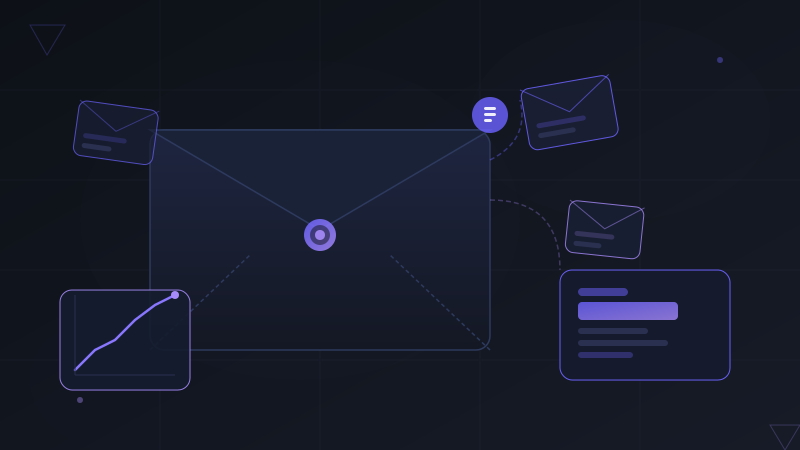
Reports of its death have been greatly exaggerated — nowhere more than in email marketing. For years, the newsletter has been declared obsolete, pushed aside by social media, stories, and reels. But the numbers tell a different story: email marketing delivers an average ROI of 36:1. That means for every dollar invested in email marketing, you get 36 back. No other digital channel comes anywhere close.
Email Beats Social Media — By the Numbers
An Instagram post reaches an average of two to five percent of your followers organically. A well-written newsletter, on the other hand, lands straight in the inbox — no algorithm, no guesswork, no extra ad budget. Typical open rates range from 20 to 40 percent depending on the industry. That's a direct, personal connection no social channel can replicate. And platforms change. Algorithms get tweaked, reach gets throttled, accounts get suspended. Your email list belongs to you alone — it doesn't depend on some tech giant's decisions, and it stays yours no matter what happens on the platforms.
Building Your List
The most valuable email list is one you've built organically. People who deliberately signed up for your newsletter are qualified leads — they actually want to hear from you. The key to growing a list is offering clear value in exchange for an email address, also known as a lead magnet. That could be a free guide, an exclusive discount, access to useful content, or a mini-course. Place your opt-in form wherever your audience is already active: on your website, at the end of blog posts, on a dedicated landing page, or after checkout. What matters most: the value you promise has to be real and specific.
What Makes a Good Newsletter?
Many companies don't fail at building the list — they fail at the quality of their emails. A good newsletter shares a few key traits:
- Clear value: Every email should give the reader something — information, entertainment, a benefit, or a solution to a problem.
- A personal tone: Don't write like a company — write like a human. Authenticity builds closeness and trust.
- A clear CTA: Every email has one clear goal. One link, one action, one clear message — not five at once.
- Good timing: Find out when your audience opens emails, and send consistently at those times.
- Mobile-optimized: More than half of all emails are opened on a phone. Design and copy need to work on small screens too.
Segmentation and Automation
Treating every subscriber the same leaves potential on the table. Segmentation means splitting your list into groups — by interest, purchase behavior, location, or stage in the buying journey — and sending each group more relevant content. Automation makes this scalable: a welcome sequence greets new subscribers automatically, builds trust, and guides them step by step toward the action you want. Behavior-based triggers — say, an email that fires when someone visits a specific page or abandons a cart — make every message significantly more relevant. Modern email tools like Mailchimp, Brevo, or ActiveCampaign make this kind of automation accessible even without technical know-how.
The Most Common Mistakes
Even good intentions can backfire in email marketing. Here are the mistakes you need to avoid:
- Purchased lists: They violate GDPR, wreck your sender reputation, and don't bring you a single qualified lead.
- Sending too often: Email daily without delivering real value, and you'll quickly get flagged as spam — and unsubscribed.
- No value: Pure promotional emails with nothing useful for the reader don't work. Aim for roughly an 80/20 split — 80 percent value, 20 percent promotion.
- No unsubscribe link: This isn't just a mistake — it's illegal. Every email needs a clear opt-out option.
The Bottom Line
Email marketing is more relevant in 2026 than ever. It's the only digital channel where you have complete control — over your list, your content, your results. Start building a high-quality list today, keep delivering real value, and you'll have one of the strongest foundations for sustainable growth. Start now — even a small list can do big things.